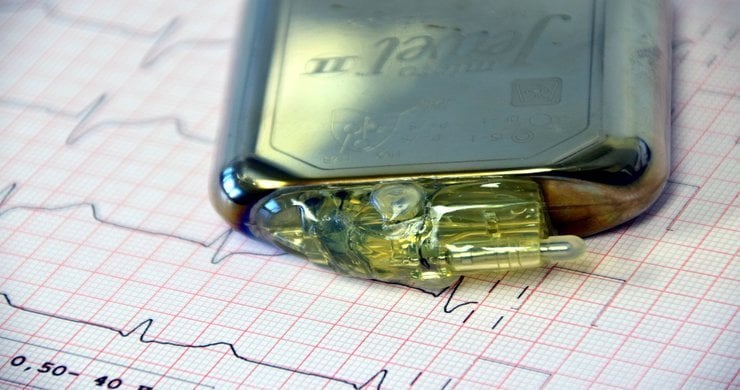
 I would like to preface this article by saying that throughout the 16 years that I’ve been in the massage chair industry and business, many customers with pacemakers have purchased and enjoyed the benefits of a massage chair. So can you use a massage chair with a pacemaker?
I have yet to hear feedback from any of those customers about deleterious effects of their robotic massage chair on the function of their pacemaker and their related health (knock on wood!).
However, I have seen and heard about massage chair owners’ manual verbiage stipulating that massage chairs are contraindications for a person with a pacemaker. Customers have also asked me about this, from time to time. Is it true? Should pacemaker patients avoid using a massage chair? Is it a serious concern? Let’s talk about that in this article, beginning with a brief discussion about the science behind massage chairs and pacemakers.
ElectroMagnetic Interference (EMI) and Pacemakers
 Nearly every electrical device creates emissions that can cause interference to the electromagnetic fields of other electrical devices. There are two types of EMI: inducted or radiating EMI and conducted EMI. Conducted EMI involves direct physical contact of one electrical device with another, while inducted EMI involves indirect, non-physical contact of one electrical device with another. Examples of conducted EMI include ignition systems, cellphone network, and lightning. Examples of inducted EMI include radio/television, power lines, computers, doorbell transformers, toaster ovens, electric blankets, bug zappers, heating pads, ultrasonic pest control devices, and touch controlled lamps. (https://en.wikipedia.org/wiki/Electromagnetic_interference#Types)
While nearly every electrical device creates emissions that can cause EMI, (i.e. electric motors, Bluetooth devices, cellphones) electric power cords and high-speed cabling are the most common sources of radiated EMI. (https://www.wireandcabletips.com/what-is-emi-and-how-can-you-prevent-it/)
When there is EMI, the function of affected electrical devices can be compromised. The compromise can be very minor and unnoticeable or it can be significant.
Massage Chair Motors and Pacemaker
Our concern in this article is the potential EMI caused by a robotic massage chair for customers implanted with a pacemaker.
 You see, massage chairs contain DC motors that facilitate various chair functions. These motors contain magnets in their construction. These magnets are an example of inducted EMI. It’s these magnets that create the EMI in question.
Based on the information I presented earlier in this article, we know that any electrical device will create some EMI for other electrical devices. Therefore, we know that the magnets in the massage chair motors create EMI. The question becomes, is the EMI created by the massage chair motors sufficient to create a problem for the function of the pacemaker or is it low enough to not merit concern?
Should You Be Concerned? Can you use a massage chair with a pacemaker?
 An article I read, entitled “Can You Use a Massage Chair with a Pacemaker?“, explores the topic of massage chairs being a contraindication for folks with a pacemaker because of EMI. The author is quite clear that a massage chair should not be used by a pacemaker patient. The logic and explanation makes sense, as I’ve shown above, but the author, who happens to be a licensed massage therapist (conflict of interest, perhaps?) does not look at the massage chair EMI context relative to other common causes of low level EMI which are around us everyday in so many ways and have little to no quantitative effect on pacemakers. (https://cybnyc.com/blog/all-categories/massage-chair-with-pacemaker/)
Most massage chair owner’s manuals even list pacemakers as a contraindication for robotic massage chair use. The general consensus among massage chair distributors is that the warnings are just in print to cover the butts of the manufacturers and distributors in the event of possible litigation.
Here is a Q&A from Human Touch, the oldest massage chair company in the USA:
“Can I use my Human Touch product if I have XYZ external or internal medical device?”
This pertains to ANY medical device, external or implant, and its susceptibility and/or sensitivity to electric motors, electric and electronic controls and common circuits which emit and/or conduct low levels of Electro Magnetic Interference (EMI).
Our products are designed and constructed in a same/similar manner as other common electrical household appliances. There is no reason to assume that our products will interfere with medical devices any more or any less than refrigerators, TVs, dishwashers, washing machines, food mixers, or other similar common household appliances. Human Touch CAN NOT in any way guarantee, advise, comment or recommend that our products will or will not negatively affect the function of medical external or internal implant devices such as, but not limited to, heart pace makers. Anyone with a concern of potential adverse effects to ANY medical device should consult with their doctor or medical device manufacturer before using or approaching this category of products (bolding added).
I think that statement and sentiment from Human Touch is adopted by most massage chair manufacturers and distributors. But, as always, if in doubt when it comes to your health concerns, following their suggestion to consult with your doctor or a medical device manufacturer is sage advice.
Dr. Alan Weidner
P.S. I welcome any comments below on this topic, from massage chair owners who happen to have a pacemaker implant or from folks who understand the science of EMI more thoroughly than my rudimentary knowledge. Any input is appreciated.