Dr. Alan Weidner:
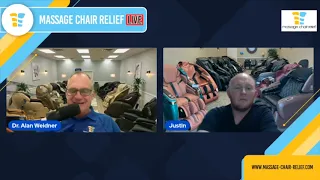
Hello, I’m Dr. Alan Weidner from Massage Chair Relief. Welcome to Part 2 of our Massage Chair Relief LIVE! broadcast with Justin Milne, expert massage chair technician and owner of Advanced Fitness Repair here in Utah.
We had such great feedback on Part 1 that we brought Justin back to continue our discussion about common repair issues, maintenance, and what customers should know about keeping their chairs in top condition.
Let’s pick up where we left off.
Dr. Alan Weidner:
Last time, we talked about failure rates and how factors like usage, environment, and quality of components affect how often chairs break down. I wanted to start this session by asking — when something goes wrong with a chair, how much of the problem is related to the brand versus just wear and tear?
Justin Milne:
Good question. Honestly, a lot of it depends on the brand’s design and quality control, but wear and tear is always part of the equation. Even a high-end chair will eventually have issues if it’s heavily used.
That said, some brands are definitely better than others at supporting customers — meaning they keep parts in stock, have good service manuals, and provide clear diagnostic tools. Others… not so much. Sometimes it’s a struggle just getting replacement parts or tech support.
Dr. Alan Weidner:
Yeah, I’ve seen that too. Some manufacturers are great about warranty service; others make it really difficult.
Justin Milne:
Exactly. When parts are easy to get, repairs are straightforward. When companies go out of business or stop supporting older models, that’s when it gets tricky.
Dr. Alan Weidner:
Let’s talk about installation errors or user setup issues. Do you often see chairs that fail just because they weren’t assembled correctly?
Justin Milne:
All the time. A lot of problems could be avoided if people followed the setup instructions carefully. Cables might not be connected properly, air hoses get pinched, or someone forgets to remove the transport bolts that lock the mechanism in place during shipping.
I always recommend having your chair assembled by a professional or at least double-checking the setup video if you’re doing it yourself.
Dr. Alan Weidner:
Good advice. Now, I wanted to ask about something that comes up in our showrooms — power surges. We’ve seen a few customers lose boards or motors after storms. What’s your take on surge protectors for massage chairs?
Justin Milne:
They’re absolutely worth it. A massage chair is a complex piece of electronics, like a computer. Power surges can fry control boards or sensors instantly. I always tell customers to use a surge protector or even better, a power conditioner if possible. It’s cheap insurance compared to the cost of replacing parts.
Dr. Alan Weidner:
That’s a great tip. What about noise? Some customers worry when they hear clicks, pops, or hums. When is noise normal, and when is it a red flag?
Justin Milne:
Good question. Some noise is completely normal — things like valves opening, airbags inflating, or motors changing direction. But if you hear grinding, scraping, or rhythmic knocking that doesn’t stop, that’s not normal. It could mean a roller arm is misaligned, a bolt came loose, or something’s caught in the mechanism.
If the noise repeats every cycle, call your dealer or a technician. Don’t just “wait and see.”
Dr. Alan Weidner:
Makes sense. Now, we talked last time about pets, food, and dust getting into chairs. What’s your recommendation for cleaning and maintenance?
Justin Milne:
Keep it simple — vacuum around the base and under the chair occasionally, especially if you have pets. Wipe down the upholstery with a damp cloth and mild soap. Avoid strong cleaners or alcohol-based products because they can damage the synthetic leather.
Also, every few months, check for loose connectors under the chair — make sure air hoses and cables are snug. That small step prevents a lot of service calls.
Dr. Alan Weidner:
You’ve mentioned before that climate can affect performance too — especially extreme heat or humidity.
Justin Milne:
Right. Keep your chair in a climate-controlled environment — avoid garages, sunrooms, or damp basements. Electronics don’t like heat or moisture. I’ve seen circuit boards rust or corrode from being stored in humid areas.
Dr. Alan Weidner:
What about overuse? In Part 1, you taught us about the “duty cycle” — how motors need rest periods. How often do you actually see chairs fail from being overused?
Justin Milne:
Quite a bit. Some families use the chair nonstop — kids jump in, parents use it, and guests use it too. Chairs aren’t built for eight hours of continuous operation. Motors overheat, wires fatigue, and the rollers wear out faster.
If multiple people use a chair daily, give it some cooldown time between sessions. That’ll extend its life a lot.
Dr. Alan Weidner:
Great advice. Now, when a customer’s chair breaks, what’s the typical repair process?
Justin Milne:
Usually, the dealer or manufacturer will start with basic troubleshooting — checking power, connections, and error codes. Once we identify the problem, they’ll ship replacement parts.
For warranty chairs, parts and labor are covered. Out-of-warranty repairs depend on the manufacturer, but a good company like Massage Chair Relief often helps customers even after warranties expire.
Dr. Alan Weidner:
We really do try. We’ve found that supporting customers after the sale builds trust — and honestly, we just want people to enjoy their chairs long-term.
Justin Milne:
And that’s why you guys have such a great reputation. Not every dealer takes care of customers like that.
Dr. Alan Weidner:
Thanks, Justin. Before we wrap up, what are your top tips for keeping a massage chair in good shape?
Justin Milne:
I’d say:
-
Use a surge protector — protect your investment.
-
Keep it clean — vacuum underneath, wipe down regularly.
-
Don’t overuse it — follow the duty cycle.
-
Keep pets away — fur and claws cause problems.
-
Use it regularly — ironically, chairs that sit unused for months can develop issues too, especially in the motors and airbags.
Dr. Alan Weidner:
That’s great advice. Justin, thank you again for sharing your time and expertise. We really appreciate it.
Justin Milne:
My pleasure, Alan. Thanks for having me again.
Dr. Alan Weidner:
And thank you to everyone watching Massage Chair Relief LIVE! If you missed Part 1, be sure to check it out on our YouTube channel.
If you found this helpful, please give us a thumbs-up, subscribe, and share this with your friends and family. It helps us spread the word about massage chairs and how to care for them properly.
I’m Dr. Alan Weidner from Massage Chair Relief, and we’ll see you on the next broadcast.