Hi, this is Dr. Alan Weidner from Massage Chair Relief, and I’d like to welcome you to a conversation with our customer, Ion Cheptene.
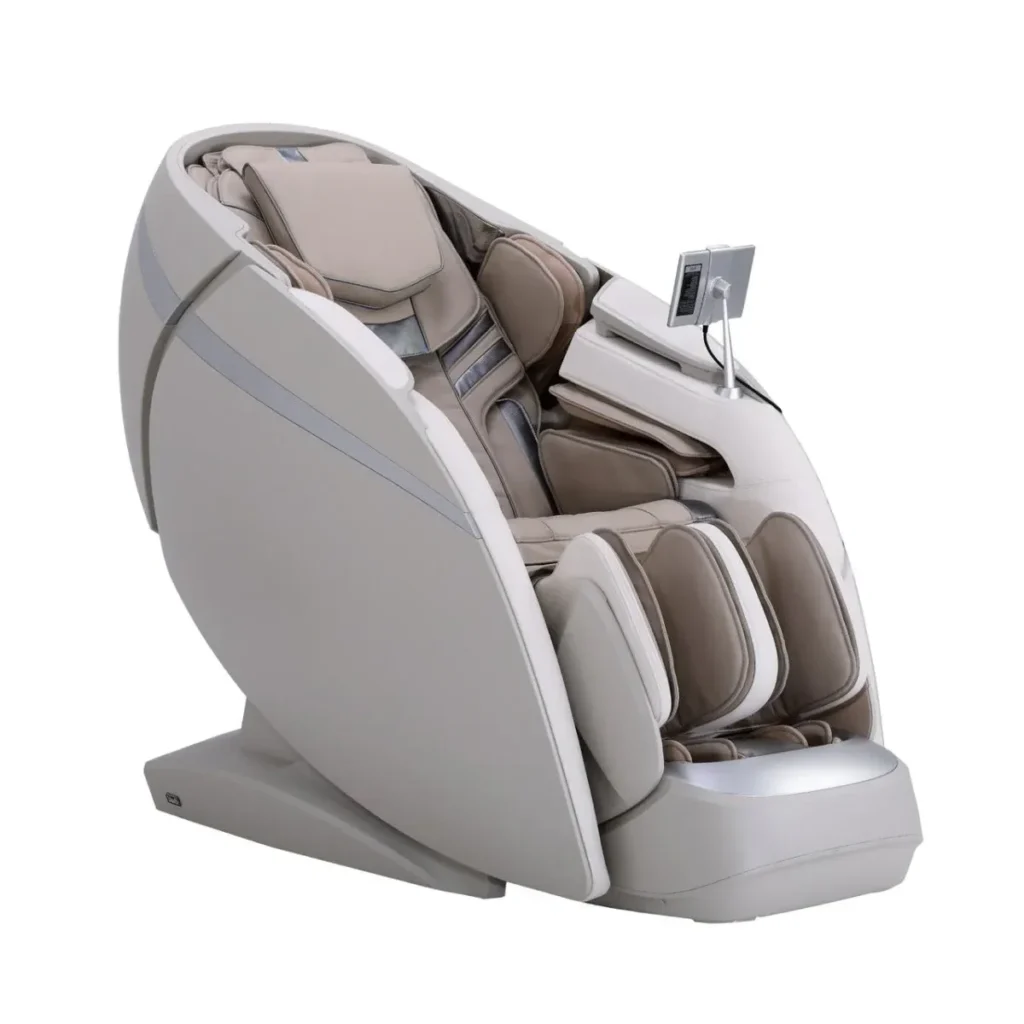
Ion is a customer from our Southern California store and purchased the Osaki DuoMax SE. Ion, welcome, and thank you so much for joining me today.
Thank you.
I really appreciate you making time for us. People are so busy, so when someone wants to be part of a conversation like this, I’m always very appreciative.
Tell me a little bit about your experience with massage chairs. Is this your first massage chair, or have you owned others before?
Yes, I’ve owned several before. I come from the world of sports. I spent 44 years in martial arts.
Oh, really?
Yes, and I went all the way to the top. Massage has always been a big part of recovery for athletes, so we’ve always valued it.
I’m originally from a small country called Moldova in Eastern Europe. When I moved to the U.S., I realized you can’t always get a real massage from a therapist—it’s very expensive. So, I purchased my first massage chair, and it was a Panasonic. I had a very good experience with it.
Then I had a second chair, I believe it was a Human Touch, and then a third one after that.
Over the years, I started paying attention to how massage chairs were developing, especially with AI technology. I always wanted to move into a high-end massage chair, so I did my research, looking for good brands.
Then I started searching for showrooms where I could actually try them.
Yeah.
That’s how I ended up at your showroom in Artesia. I Googled many times, trying to find a place close to my house that also offered a variety of chairs to test.
Artesia, yes.
Now, when you came to the showroom, having owned massage chairs before, you probably felt like a kid in a candy store. I think we have around 20 chairs there. Was it overwhelming? Was it difficult to narrow down what you liked?
Yes, that was exactly my first feeling—how in the world was I going to find the right one with my limited time? I didn’t want to spend 10 hours in the showroom.
But the salesperson, Mike, did a really good job. He quickly understood what I was looking for and helped narrow things down.
He gave me the big picture and explained, “This side has these types of chairs, that side has those.” He suggested where I should start, and that helped me narrow it down to several models that matched exactly what I was looking for.
Eventually, I narrowed it down to a few brands and then tried the Osaki—which I honestly wasn’t considering at first. I was thinking about a different brand, but I ended up with the Osaki I wanted.
Did the newer technology surprise you at all? Things like dual roller mechanisms, split tracks, and AI features?
Yes, absolutely. Twenty years ago, massage chairs looked completely different.
Now, the variety—not just of brands, but of techniques within one brand—is really amazing.
In the past, if I could have gotten a real massage every day, I probably wouldn’t have thought much about a massage chair. But with today’s technology, it’s incredible. Sometimes it really feels like human hands.
It’s very sophisticated, and so far I’ve enjoyed everything I’ve experienced with my massage chair.
Do you use it daily?
Yes, every day. I became a massage addict.
I train daily, and after training, I always end up in the massage chair. Sometimes my wife finds me asleep in it because I fall asleep during the massage.
Understood.
I use it daily because I understand how important recovery is for our bodies.
When you go to the gym, your body doesn’t change during the workout—it changes during recovery, when you sleep and when your body prepares for the next day.
After a certain age, a massage chair is no longer a luxury—it becomes a necessity.
I understand that now, and I even tell other people, “You should try this.”
Now all my friends come over and spend time in my massage chair too.
Well, the DuoMax SE is a great chair. It’s one of our top-selling models. It has calf rollers, foot rollers, and arm rollers—not many chairs have all three. And those arm rollers are pretty intense. Did you find them too strong?
No, not at all, because I like deep-tissue, strong massage.
For me, it wasn’t too intense. And I like that you can control the intensity very well.
It’s also combined with stretching and different massage techniques, which makes it very enjoyable and pleasant.
Massage chairs have really come a long way.
When I started over 20 years ago, all we had were rollers going up and down the back. Then we got arm airbags and foot airbags.
Panasonic was one of the first brands we carried, and it was a very good chair. But Chinese manufacturers have really advanced the industry—split-track technology, multiple roller systems, arm rollers—it has evolved tremendously.
Does your wife use the chair too?
Yes, she does, though not as long as I do.
And like I said, not only my wife, but all my friends and guests try it too.
The design is also very nice. Compared to my Panasonic 20 years ago—which was a nice chair but not very stylish—today’s chairs look futuristic and beautiful in the home while also helping maintain your body.
Do you still deal with much pain from your years in athletics?
Yes, although maybe not as much because I had good instructors who helped protect us.
But in professional sports, it’s impossible not to get injured or deal with pain.
For martial arts, lower back pain is a big issue. By the evening, you really start to feel it—and that’s where the massage chair helps.
I also do a lot of work with the Olympic bar and horizontal bar exercises, and I started having pain in my elbows.
When I discovered the Osaki arm massage technology—the one that massages your arms like piano keys—I really saw the benefit. My elbow pain is gone now.
That’s fantastic.
You made an interesting point about restorative care. Massage chairs are often associated with pain relief and stress reduction, but recovery and restoration are just as important—especially for athletes.
That’s not something we talk about enough.
Yes, recovery is one of the most important parts of optimal health.
Anyone who takes a holistic approach to health values massage.
You’ve clearly taken good care of your body over the years, but even then, the body still develops aches, pains, tight muscles, and scar tissue. A massage chair can help with all of that.
Yes, exactly.
Stretching is also a huge part of recovery, and I like that modern chairs now include stretching programs.
I especially enjoy the Thai massage mode in the Osaki because it really stretches you, and you can feel it.
It’s not only pleasant—it’s very helpful.
Not every chair has that kind of strong stretch. Some models, like the DuoMax, D.Core Hybrid, or Osaki Solis, offer very strong stretch programs, while others don’t.
That can vary a lot from model to model.
Yes, and massage chairs are like food—you like certain types and dislike others.
That’s something that really amazed me in the showroom: the variety.
One chair may be better for neck massage, another better for calves. They all do many things, but some are especially good at certain areas.
That’s why you can really find what fits your own needs.
That’s exactly what I talk about in my videos—every chair feels different to every person.
Someone can sit in five chairs and only love one of them, while someone else might prefer a completely different one.
That’s why buying online without trying a chair first can be risky.
You might get it home and realize it doesn’t feel the way you expected—or it doesn’t reach the area you need most.
Returns are a huge hassle.
I think you did the smart thing by finding a showroom first.
Yes, absolutely.
It took me time to find a place like yours. Most showrooms carry only a few brands, but your store had the variety I needed.
That’s what made the trip worthwhile.
I’m glad to hear that.
Do you have any advice for someone looking to buy a massage chair?
Yes—first, be clear about what you really want.
If I go to a massage therapist, I’ll say, “Please focus on my neck and lower back.”
You should approach a massage chair the same way.
Know what areas matter most to you so the salesperson can help guide you to the right chairs.
Many times, people shop online and see attractive prices, but if you buy something you don’t really understand, it doesn’t matter how cheap it is—you won’t enjoy it.
That’s why I believe the best way is to go to a showroom, try the chairs, and find the brand you truly enjoy.
So, to summarize: define what you want, and try it.
That’s excellent advice.
And hopefully there’s a showroom nearby for people—that’s often the challenge.
Yes, and I’d add one more thing.
All chairs look nice from the outside, especially online. But the prices can be very different.
Only when you try them do you realize that quality matches price.
I also fell into the trap of looking at chairs that were very affordable and looked great—but they didn’t have the quality a good brand offers.
So I would say: don’t fall for cheap prices, because they usually won’t give you the quality you need.
You get what you pay for.
Especially in our industry, that is very true.
That’s another great tip. Thank you.
It was wonderful visiting with you, Ion. I really appreciate you taking the time to speak with me and share your perspective—especially from an athlete’s point of view.
You gave some fantastic advice, not just for athletes, but for everyone.
Thank you again.
Thank you, Alan.
We’ll see you next time. Bye-bye.